AI in Healthcare
Published 3/8/2026
With Artificial Intelligence (AI) being so front and center in society’s psyche right now, there are tons of questions about what it really is, how it’s used, and what the future looks like. While nobody can predict the future, it is possible to gain a better understanding of AI as a whole and its uses, specifically within medicine and the medical field.
What is AI?
IBM said it best: “Artificial intelligence (AI) is technology that enables computers and machines to simulate human learning, comprehension, problem solving, decision making, creativity and autonomy” (Stryker et. al). There are several “subsets” of AI, but most recently, generative AI has been all the buzz. According to Stryker et. al, generative AI is capable of creating original content— images, text, audio, videos, and more. Before generative AI, there was machine learning and deep learning— models that could learn from the past, and models that could sort of “think” like a person (Stryker et. al). Below is a short video that explains AI in a little more detail.
A Brief History of AI in Medicine
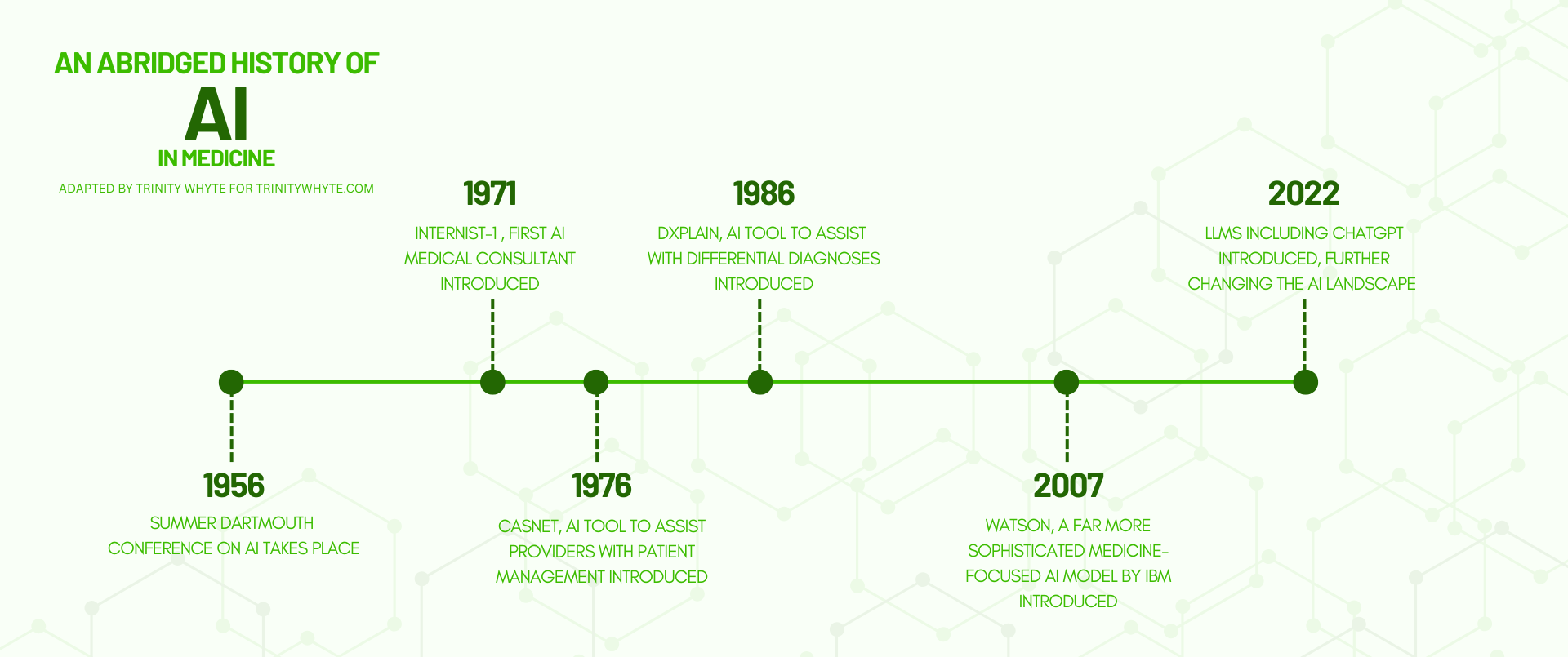
AI as many of us know it is a relatively new idea, but its foundations go all the way back to the 1950s. According to Hirani et. al, the 1956 Summer Dartmouth Conference on AI is understood as the first “true conception” of AI (2024). At this conference, many scientists, mathematicians, and engineers came together to discuss AI and its future applications (Hirani et. al, 2024). However, it wasn’t until the 1970s that AI really started to pick up in medicine.
One of the very first medical AI models, INTERNIST-1, was created in 1971 to be a medical consultant—providers could input symptoms, and it would come up with a clinical diagnosis (Hirani et. al, 2024). CASNET, which was developed a few years later in 1976, could be used to “apply information about a specific disease to individual patients and provide physicians with advice on patient management” (Kaul et. al, 2020). DXplain, a system similar to INTERNIST-1, arrived in 1986; it was able to produce differential diagnoses based on user input and could provide information on many different diseases (Kaul et. al, 2020). Much more recently, in 2007, IBM created a Watson, which was able to output more than just diagnoses, making it more advanced than previous models (Hirani et. al, 2024). The type of AI that’s all the buzz, Large Language Models like ChatGPT, were introduced in 2022 and provide even more exciting new possibilities for medicine (Stryker et. al).
AI’s Use in Medicine
AI has only become more and more complex as time has gone on—that much is clear. Now, AI has been integrated into so many different dimensions of healthcare and medicine. According to the Cleveland Clinic, it’s currently being used to read diagnostic imagery and flag potential areas of concern for providers to follow up on and to create treatment plans personalized to each patient (“How AI Is Being Used in Healthcare — and What It Means for You”, 2025). Furthermore, physicians are using AI to assist with some of their administrative burden. They report using AI for documenting billing and visit notes, creating care plans, and summarizing research and patient data (Henry, 2025).
It’s clear from an AMA report that physicians are utilizing and enjoying its benefits— in 2024, 66% of physicians surveyed used AI, and 68% reported it had “at least some advantage in patient care” (Henry, 2025). Patients are also enjoying its benefits too. AI chatbots are taking a more active role in healthcare—they can “triage symptoms, answer medication questions, provide chronic disease coaching, and guide patients through care pathways” (Handler, 2026). They can also send patients refill reminders, assist with video visits, and more (“How AI Is Being Used in Healthcare — and What It Means for You”, 2025). Below is an interesting video about how AI is impacting radiology.
A Quick Word on Ethical Concerns
Despite its benefits, the use of AI brings up some interesting ethical questions and concerns. Perhaps one of the biggest concerns is bias. Dankwa-Mullen brought up a couple of particularly interesting examples: experience and expertise bias and exclusion bias (2024). The former basically refers to the fact that AI’s quality is impacted by those who actually work on the models and how providers’ experience (or lack thereof) can impact their understanding and usage of the information provided. The latter refers in part to underrepresentation—some groups are underrepresented in research, which impacts the information that models have access to. This can cause systems to provide answers that represent only part of the total population (Dankwa-Mullen, 2024).
Another interesting concern is paternalism. Providers have begun embracing a less paternalistic style of medicine, but Savulescu et. al believes that “machine paternalism” may rise (2024). Machine paternalism is the idea that AI will make recommendations based on its programmers’ values, not the values or wishes of patients (Savulescu et. al, 2024). In other words, the model is telling the providers and patients what next steps should be based on what a programmer thinks is most important without considering the patients themselves. These are just a couple of examples of ethical questions being explored with the rise of AI in medicine—there are plenty more, and surely more will come up as this technology progresses and becomes more integrated into the medical field.
Moving Forward
At least for now, it seems like AI is here to stay in the medical field. It makes life easier for providers and provides a new dimension to healthcare for patients. For better or worse, these benefits may ultimately outweigh the ethical concerns that exist with these tools. Ultimately, only time will tell how AI will impact patient outcomes and how integrated it will become into medicine and patient care.
References
Dankwa-Mullan, I. (2024, August 22). Health Equity and Ethical Considerations in Using Artificial Intelligence in Public Health and Medicine. CDC, 21. http://dx.doi.org/10.5888/pcd21.240245
Good Things Foundation. (2024, May 14). Introduction to Artificial Intelligence [Online video]. YouTube. https://www.youtube.com/watch?v=vBePahzcXfc
Handler, R. (2026, January 15). Clinical AI Has Boomed. Stanford Medicine. https://medicine.stanford.edu/news/current-news/standard-news/clinical-ai-has-boomed.html
Henry, T. A. (2025, February 26). 2 in 3 physicians are using health AI—up 78% from 2023. American Medical Association. https://www.ama-assn.org/practice-management/digital-health/2-3-physicians-are-using-health-ai-78-2023
Hirani, R., Noruzi, K., Khuram, H., Hussaini, A. S., Aifuwa, E. I., Ely, K. E., Lewis, J. M., Gabr, A. E., Smiley, A., Tiwari, R. K., & Etienne, M. (2024). Artificial Intelligence and Healthcare: A Journey through History, Present Innovations, and Future Possibilities. Life (Basel, Switzerland), 14(5), 557. https://doi.org/10.3390/life14050557
How AI Is Being Used in Healthcare — and What It Means for You (2025, December 22). Cleveland Clinic. https://health.clevelandclinic.org/ai-in-healthcare
Kaul, V., Enslin, S., Gross, S. A. (2020, October). History of artificial intelligence in medicine. Gastrointestinal Endoscopy, 92(4), 807-812. https://doi.org/10.1016/j.gie.2020.06.040
Savulescu, J., Guibilini, A., Vandersluis, R., Mishra, A. (2024, March 26). Ethics of artificial intelligence in medicine. Singapore Medical Journal. https://doi.org/ 10.4103/singaporemedj.SMJ-2023-279
Stryker, C., & Kavlakoglu, E. (n.d.). What is artificial intelligence (AI)?. IBM. https://www.ibm.com/think/topics/artificial-intelligence
Time. (2022, November 4). How AI Could Change the Future of Medicine [Online video]. YouTube. https://www.youtube.com/watch?v=YSQRWOy2Om4